Wrist movement
The sensor records acceleration and rotation at your wrist. The algorithm picks out an individual swing from the surrounding movements.
The sensor records acceleration and rotation at your wrist. The algorithm picks out an individual swing from the surrounding movements.
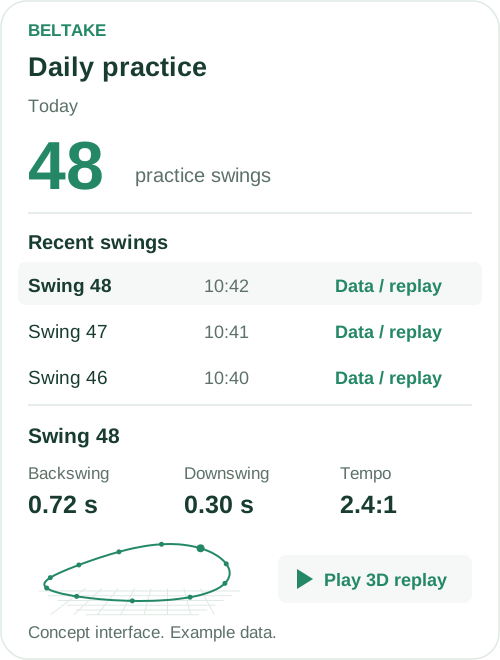
Each record shows how long you spent going back and coming down. Dividing backswing time by downswing time gives the tempo ratio.
The reconstructed line traces wrist movement through the swing. Overlay several records to see which part of the path varies from one swing to the next.
A professional golfer’s wrist trajectory gives you a shape to study. Your coach’s phase times give you a rhythm to try. Choose references that fit what you are practising.
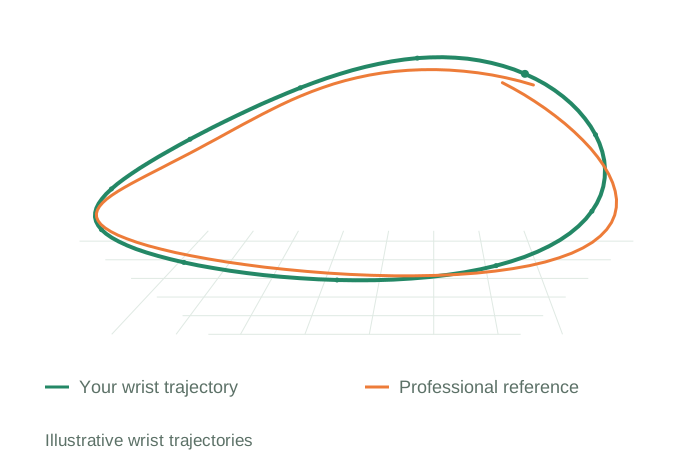
Follow one section of the curve at a time. If your own paths spread apart at the same point over several swings, bring that part of the replay to your coach.
| Measurement | Your swing | Coach reference |
|---|---|---|
| Backswing | 0.72 s | 0.90 s |
| Downswing | 0.30 s | 0.30 s |
| Tempo | 2.4:1 | 3.0:1 |
Here the two downswings take the same time. The golfer’s backswing is 0.18 seconds shorter, which accounts for the difference in tempo.
In the timing example, an AI practice suggestion could be to take a little more time on the backswing. On your next set, compare the phase times and replay the wrist paths to see what changed.
The app keeps a daily swing count. Open an individual record to review its timing and 3D replay alongside the rest of the session.